Description
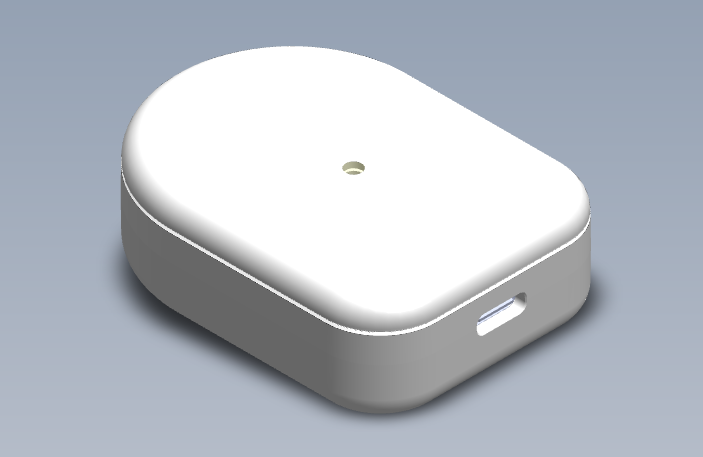
The PT321 is an Ultra-Wideband (UWB) tag designed for use with Ciholas UWB (CUWB) Real-Time Location Systems (RTLS). In a CUWB RTLS deployment the PT321 operates as a mobile, trackable device that can be attached to personnel, equipment, and assets. Featuring a user-replaceable battery, the PT321 is lightweight and designed for easy mounting on a wide variety of objects.
Features
- Operates with Ciholas CUWB System
- Ultra-Wideband Radio
- Supports UWB Channel 5 and Channel 9
- Data rate 6.8Mbps
- Integrated Radio Frequency (RF)
- Omni-directional UWB antenna
- Variable beacon rates
- Built-in Low-Noise Amplifier (LNA)
- Long RF range
- Status & Control
- Tri-Color LED Indicator
- Wake-on-Shake
- Firmware updates by UWB or USB
- Power & Connectivity
- Uses a CR123A User-Replaceable Battery1
- USB data connection:
- Fully compliant with USB 2.0 specification
- Standard USB Type-C Receptacle
- Low Power & Long Battery Life
- Certifications
- FCC Certified in the United States
- CE Marking in the European Union
- ISED Certified in Canada
- MIC Certified in Japan
- Mechanical
- IPX7 Rating
- Mounting Accessories - Coming Soon
1. Battery charging not supported.
Ordering
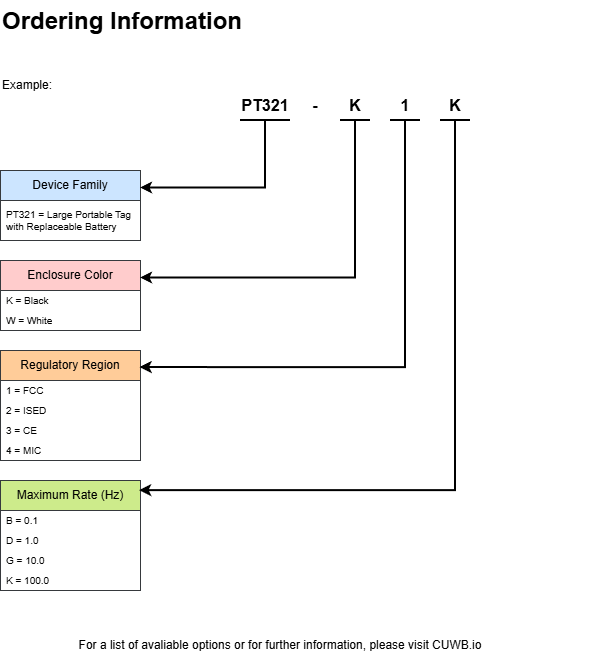
The PT321 maximum beacon rate is specified for each selected model. Devices can be configured to beacon at any frequency up-to and including the maximum rate. Each PT321 unit is region-locked at time of purchase to ensure compliance with local regulatory requirements. See regulatory compliance for supported regions and compliance statements.
Available from the Ciholas Webshop. Battery is not included.
Electrical
Ratings
| Parameter | Description | Min. | Typ. | Max | Units |
|---|---|---|---|---|---|
| T | Operational Temperature | -20 | 60 | °C |
RF Characteristics
| Channel1 | Center Frequency | Bandwidth | Maximum Distance2 |
|---|---|---|---|
| 5 | 6.4896 GHz | 499.2 MHz | 90 meters |
| 9 | 7.9872 GHz | 499.2 MHz | 80 meters |
1. Where channel usage is allowed. Not all channels are supported in every regulatory region.
2. In clear Line-of-Sight conditions.
Battery Life Examples
Operational mode sets the foundation of power consumption. PT321 power use is highly dependant on usage and system configuration. Devices configured with beacon rates higher than listed will draw more power.
The following chart depicts the typical battery runtime at 25°C under conditions where Wake-on-Shake features are disabled, the command rate is configured for 0.1 Hz, LEDs are turned off, and no additional user data is used. Tested with Duracell® CR123A battery (typ. capacity 1550mAh).
| UWB Channel | Beacon Rate (Hz) | MultiRange Typical Runtime (Days) | MultiTime Typical Runtime (Days) |
|---|---|---|---|
| 5 | 0.1 | 2200 | 2260 |
| 5 | 1 | 470 | 1100 |
| 5 | 10 | 50 | 195 |
| 5 | 100 | 5 | 20 |
| 5 | 200 | N/A1 | 12 |
| 9 | 0.1 | 1995 | 2175 |
| 9 | 1 | 400 | 1000 |
| 9 | 10 | 40 | 170 |
| 9 | 100 | 4 | 20 |
| 9 | 200 | N/A1 | 12 |
1. 200 Hz beacon rate not compatible with MultiRange mode.
Mechanical
| Parameter | Description | Min. | Typ. | Max | Units |
|---|---|---|---|---|---|
| Unit Mass | ABS Plastic w/ Flame Retardant - UL94 V0 | 46.9 | g | ||
| Drop Rating | 2 | m | |||
| Ingress Protection | IPX7 | 1 | m |
Dimension Drawing
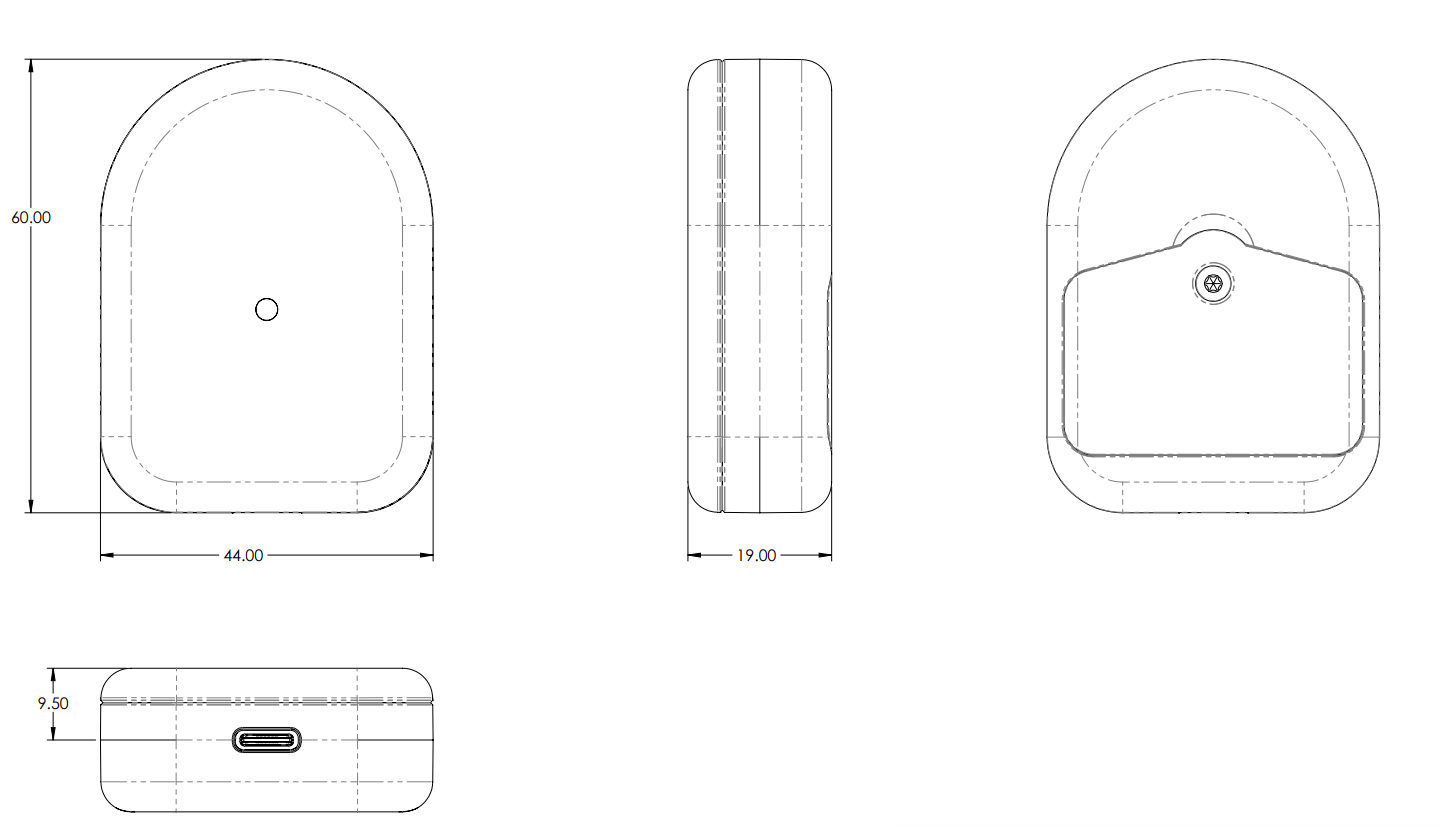
All dimensions are in millimeters unless otherwise stated.
Downloadable Models
Antenna Center
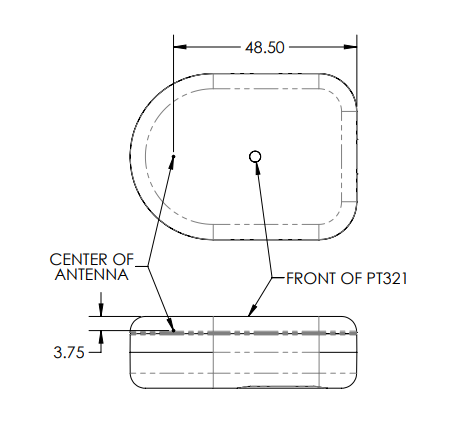
The following drawing indicates the center of the antenna for the PT321. For best tracking performance, attach the Tag such that the RGB LED faces away from the object.
Operation
Power
USB
The PT321 uses a USB Type-C connector for external power and for optional local communication. The PT321 does not support charging a battery, see Battery section for details.
When USB power is first applied to a PT321, it will cause a full device reset.
Battery
The PT321 receives power from an internal battery that can be replaced by a user. The PT321 supports using either a CR123/CR123A primary cell battery or a 16340 rechargeable battery.
The PT321 does not support battery charging. If using a rechargeable battery, the battery will need to be removed and charged separately, following specific charging guidance from the battery manufacturer.
Runtime may vary when using different brands. Using a non-lithium primary cell chemistry may reduce available runtime. Battery percentage reporting is available on the PT321 in the CUWB Viewer.
Shipping
A battery is not provided. When shipping a device, remove the battery and follow applicable shipping regulations for the battery.
Installing the battery
The battery is not installed prior to shipping. Install battery prior to first use.
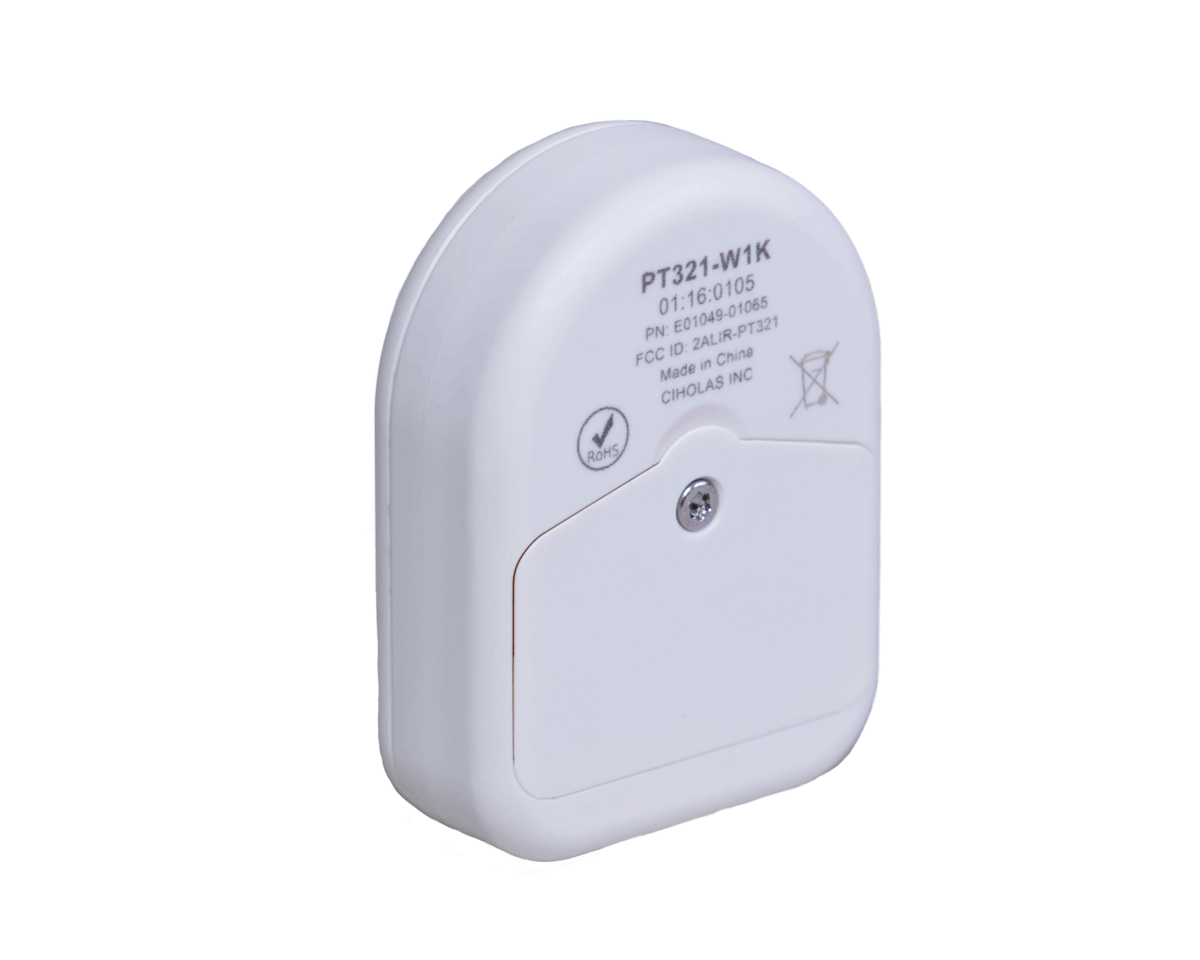
To install or change the battery, you will need the following:
- New battery
- Torx T8 drive screwdriver for M2.5 screw
- Unpackage battery.
- Use the screwdriver to open sealed battery compartment.
- Note the battery polarity and carefully insert battery.
- Reinstall battery compartment cover and screw closed with 3in-lb of torque to seal the cover.
Improper torque on the battery compartment cover could lead to water intrusion and void warranties.
Communication
When connected to a USB host, the PT321 will enumerate as a USB device with the VID:PID of 0x0483:0x5740 and USB speed grade Full Speed (12 Mbit/s).
To connect with the PT321 and configure the device to be a wired device in a CUWBNet, see CUWB USB Driver for additional information.
The PT321 communicates via USB using the Ciholas Serial Protocol. For additional information on serial packet formatting, see Ciholas Serial Protocol.
Firmware Updates
The PT321 can be updated with new firmware releases by using the CUWB Manager. The PT321 supports Over-the-Air (OTA) by UWB and wired updates by USB. See Firmware Updates for instructions. The latest firmware packages are available on the Software Downloads page.
CUWBNet Operation and Configuration
CUWBNet Join
After a battery is installed, the PT321 automatically attempts to join any CUWBNet that is within range of its UWB transceiver. To conserve energy, the device listens on a periodic schedule. Initially, the time between searches is low to allow for a fast join.
If no CUWBNet is found, the period between searches increases over time. Eventually, if no CUWBNet is detected, the device will utilize the slowest search period. The slowest search period is once every 640 seconds. See CUWBNet Search in the CUWB Manager Manual for additional information on search periods.
The search period described above is reset any time the PT321 is plugged into USB power. If a device is taking longer than expected to join, plugging it into a powered USB port will reset the listen period and allow it to join more quickly.
Wake-on-Shake will also modify the listen period for tags. See Wake-on-Shake section below.
CUWBNet Configuration
PT321 devices must be added to the CUWB configuration in order to join a CUWBNet and begin beaconing. Details regarding PT321 setup and configuration for the CUWB RTLS can be found in the CUWB Manager.
Wake on Shake
The PT321 supports Wake-on-Shake CUWBNet Search. Wake-on-Shake is enabled by default and allows the device to enter low-power sleep when not participating in a CUWBNet. When the device is steady and no motion is detected, the device will enter a low-power mode, searching for CUWBNets infrequently. Any time the PT321 detects motion, it will exit the low-power mode and search for CUWBNets at a much higher rate.
If the PT321 is powered by USB, it will hunt for a CUWBNet every 5 seconds regardless of motion.
The Wake-on-Shake feature is adjustable when the PT321 is active on a CUWBNet. For detailed information on this feature and its settings, see Wake-on-Shake CUWBNet Search.
LED Indication
The PT321 has a tri-color (RGB) LED for conveying device state to users. In normal operation1 the device state can be determined using the table below:
| Status | Battery | Color | ON Time | Period |
|---|---|---|---|---|
| ON CUWBNet | <10% | Red | 10mS | 1.0S |
| ON CUWBNet | 10-100% | Green | 10mS | 1.0S |
| OFF CUWBNet | <10% | Red | 10mS | 10.0S |
| OFF CUWBNet2 | 10-100% | Green | 10mS | 10.0S |
| Power On Reset3 | N/A | Blue | 500mS | N/A |
| USB Enumeration4 | N/A | White | 0.25-5.0S | N/A |
1. This table denotes normal LED operation. The CUWB Manager can be configured to show different LED patterns.
2. Off CUWBNet behaviors are a double green blink, and will reduce in frequency for power savings the longer the device is off the CUWBNet. This may be as long as 640 seconds if wake-on-shake features are enabled.
3. Power On Reset (POR) occurs only on system reset. This will happen upon powered USB cable insertion, on reboot after firmware update, and when the device resets due to system watchdog. If a device remains on with a solid blue LED, the firmware is invalid.
4. USB Enumeration time may vary.
The LED on the PT321 can be completely disabled. See the CUWB Manager Reference Manual for configuration details.
Error Handling
The RGB LED also conveys error states to the user. An error is indicated by a 500 ms red flash followed by a color sequence.

The following color sequences are used to decode error states:
| Color Sequence | Code | Description |
|---|---|---|
| Red — White-White-White | 0 | UWB IC Communication Error |
| Red — Magenta-Magenta-White | 20 | No valid Search Parameters available |
| Red — Blue-White-White | 32 | Hard Fault |
| Red — Blue-White-magenta | 33 | Watchdog |
[CODE 0] - UWB IC Communication Error
This indicates that the PT321 firmware is unable to communicate with the UWB transceiver. Plug the PT321 into a USB host device to cause a system reset. If the problem persists please contact Ciholas for support.
[CODE 20] - No valid Search Parameters
If the problem persists please contact Ciholas for support.
[CODE 32] - Hard Fault
If the problem persists please contact Ciholas for support.
[CODE 33] - Watchdog
If the problem persists please contact Ciholas for support.
Regulatory Compliance
The PT321’s regulatory certification is selected at the time of purchase. The device may only be used in regions covered by its certification and must be operated in accordance with all applicable regulatory limitations.
Federal Communications Commission (FCC) - USA
FCC ID: 2ALIR-PT321
This device complies with part 15 of the FCC Rules. Operation is subject to the following two conditions: (1) This device may not cause harmful interference, and (2) this device must accept any interference received, including interference that may cause undesired operation.
NOTE: This equipment has been tested and found to comply with the limits for a Class B digital device, pursuant to Part 15 of the FCC Rules. These limits are designed to provide reasonable protection against harmful interference in a residential installation. This equipment generates, uses, and can radiate radio frequency energy and, if not installed and used in accordance with the instructions, may cause harmful interference to radio communications. However, there is no guarantee that interference will not occur in a particular installation. If this equipment does cause harmful interference to radio or television reception, which can be determined by turning the equipment off and on, the user is encouraged to try to correct the interference by one of the following measures:
- Reorient or relocate the receiving antenna.
- Increase the separation between the equipment and receiver.
- Connect the equipment into an outlet on a circuit different from that to which the receiver is connected.
- Consult the dealer or an experienced radio/TV technician for help.
Changes or modifications not expressly approved by Ciholas, Inc. can void your authority to operate this equipment under Federal Communications Commission rules.
Operation on board an aircraft, ship, or a satellite is prohibited. Devices operating under this section may not be employed for the operation of toys.
The use of a fixed outdoor infrastructure is prohibited. A fixed infrastructure includes antennas mounted on outdoor structures, e.g., antennas mounted on the outside of a building or on a telephone pole.
UWB devices operating under the provisions of 15.519 may operate indoors or outdoors.
Radiation Exposure Statement: The device has been found to be exempt from SAR under KDB 447498 D01 v06 Section 4.3.1. This device may be used in an uncontrolled environment.
Innovation, Science and Economic Development (ISED) - Canada
IC:26788-PT321
CAN ICES-3 (B)/NMB-3(B)
This device complies with Industry Canada’s license-exempt RSSs. Operation is subject to the following two conditions:
- This device may not cause interference; and
- This device must accept any interference, including interference that may cause undesired operation of the device.
Le présent appareil est conforme aux CNR d’Industrie Canada applicables aux appareils radio exempts de licence. L’exploitation est autorisée aux deux conditions suivantes :
- l’appareil ne doit pas produire de brouillage;
- l’appareil doit accepter tout brouillage radioélectrique subi, même si le brouillage est susceptible d’en compromettre le fonctionnement.
Applicable rules: RSS-220
Radiation Exposure Statement: The device has been found to be exempt from SAR under KDB 447498 D01 v06 Section 4.3.1 and Industry Canada RSS-102 Section 6. This device may be used in an uncontrolled environment.
Déclaration relative à l’exposition aux rayonnements: L’appareil est exempté du DAS en vertu de la norme KDB 447498 D01 v06, section 4.3.1, et de la norme RSS-102 d’Industrie Canada. Cet appareil peut être utilisé dans un environnement non contrôlé.
European Conformity (CE) - EU
Hereby, Ciholas declares that this device is in compliance with the essential requirements and other provisions of Directive 2014/53/EU, 2014/30/EU, and 2011/65/EU.
The full text of the EU Declaration of Conformity is available: PT321 Declaration of Conformity.
Ministry of Internal Affairs and Communications (MIC) - Japan
PT321
MIC: 217-263271
警告: この装置は屋内でのみ操作できます。屋外での運用は総務省電波法の規制に違反し、運用者は重大な法的罰則を受ける可能性があります。
WARNING: This equipment may only be operated indoors. Operation outdoors is in violation of Japan MIC Radio Law regulations and could subject the operator to serious legal penalties.
航空機や人工衛星に搭載しての運用は禁止されています。本条項に基づいて動作する機器を、玩具の操作に使用することはできません
Operation on board aircraft or satellites is prohibited. Devices operating under this section may not be employed for the operation of toys.
放射線被曝に関する声明: 無線機器の平均電力が 20 mW 未満であるため、このデバイスは人体 SAR 規制の対象外であることが確認されています。
Radiation Exposure Statement: The device has been found to be exempt from Body-SAR regulations due to the average power of the radio equipment being less than 20 mW.
Product Warnings

- Before working or installing electrical equipment, be aware of the hazards involved with electrical circuitry and be familiar with standard practices for preventing accidents.

- Usage of this product outside the parameters outlined in the user manual can result in bodily injury and damage to this and other equipment. To prevent this, please follow all instructions in the user manual.
- Installation of this equipment must comply with all local and national electrical codes.
- Do not operate any wireless devices near unshielded blasting caps or in an explosive environment unless the devices have been specifically modified and certified for such use.
Revision
| Version | Date | Change Description |
|---|---|---|
| 5.1.0 | 2026-08-28 | Preliminary Datasheet Release |
| 5.0.1 | 2026-01-14 | Correcting Ordering Information Chart |
| 5.0.0 | 2025-10-31 | Initial Preview Release |
APPENDIX A : License Terms and Conditions
General Terms and Conditions of Purchase/Service
These General Terms of Purchase/Service are a legal Agreement between you and Ciholas, Inc. (“Ciholas”), and govern your use of all Ciholas services and products, which include, but are not limited to, CUWB.io, Ciholas.com, and all Ciholas Products, Software, and Hardware. If you are accessing and/or using any of the Ciholas services and products on behalf of your employer or as an agent of a third party, your employer or third party is bound to these terms.
Please read these General Terms carefully. Your use of these services and products indicates that you have read, understand, and agree to be bound by the terms herein. Any attempt to set up, use, or install these products constitutes your assent to all the terms of this Agreement. If you disagree with this or any of our other policies, please do not install or use our services and products, and see our return policies for instructions regarding our 60-day Money-Back Guarantee. Written approval is not a prerequisite to the validity and enforceability of this Agreement. Ciholas reserves the right to amend and/or update these terms from time to time. Such modifications to this Agreement will be posted to the website and bundled with software revisions.
This Agreement constitutes the entire and exclusive Agreement between Licensor and Licensee regarding Ciholas services and products, unless modified and agreed to in writing by both parties. We may terminate or suspend access to our services and products at any time, without prior notice or liability, for any reason whatsoever, and without limitation if you breach the General Terms. All provisions of the General Terms shall survive termination, including, without limitation, ownership provisions, warranty disclaimers, indemnity, and limitations of liability. If any provision of this Agreement is deemed invalid or unenforceable, the remaining provisions shall remain in full force and effect.
Any customized services and products will be governed under a separate Customization Agreement.
Definitions
For purposes of this Agreement, the following terms shall have the following meanings, unless the context clearly requires otherwise:
“Agreement” means this General Terms of Purchase/Service Agreement and Technology License, any exhibits or appendices attached hereto, and any documents incorporated by reference.
“Buyer” means a person or entity that purchases or contracts to purchase products, services, or property from Ciholas.
“Ciholas” means Ciholas, Inc. including any entity controlled by Ciholas, Inc.
“End-User” means the person or entity that receives and uses Ciholas services and/or products.
“Firmware” means a code segment compiled into binary machine code that is embedded inside a device.
“Hardware” means the physical components of the Ciholas UWB Systems, such as anchors, tags, and supporting equipment.
“Indemnitee” includes, but is not limited to, all End-Users, Buyers, and/or Licensees.
“License Configuration” means a particular configuration or setting provided with Ciholas services and/or products for the purposes of meeting regulatory requirements, or ensuring performance to specification.
“Licensee” means any individual or entity who purchases or uses Ciholas services and/or products covered by this Agreement.
“Licensor” means Ciholas, Inc. including any entity controlled by Ciholas, Inc.
“Our” means Ciholas, Inc. including any entity controlled by Ciholas, Inc.
“Personal Identifiable Information (PII)” means any identifying information unique to you that is made available to Ciholas when you browse our sites, create accounts on our sites, purchase and use our services and products, and/or contact us through our support phone number /email.
“Products” means any goods and/or services provided by Ciholas that are covered under this Agreement.
“Services” means services ancillary to the support and operation of Ciholas Products, Software, Firmware, or Hardware.
“Software” means programs or sets of instructions, including associated source code, object code, documentation, and data, which enable End-Users to perform specific operations or series of operations.
“Technology License” means the License granted to the Licensee for the use of Ciholas services and products through this Agreement.
“We” means Ciholas, Inc. including any entity controlled by Ciholas, Inc.
“You” means the person or entity entering into this Agreement with Ciholas.
Technology License
Subject to the terms and conditions of this Agreement, Ciholas grants to you, the Licensee, a limited, non-exclusive, license to use CUWB Software and CUWB Hardware containing Ciholas’ Intellectual Property and patent-protected technologies. Ciholas remains the owner of all titles, rights, and interests in the CUWB Software, CUWB Hardware, and other Ciholas products.
Unless expressly stated otherwise, all Software constitutes original code and is subject to the License. Any use of the Software must be in compliance with the License. You acknowledge that the Software and the underlying ideas or concepts of the services and/or products are valuable intellectual property, and you agree not to, except as expressly authorized and only to the extent applicable by statutory law, attempt (or permit others to attempt) to decipher, decompile, disassemble, modify, or otherwise reverse engineer, or attempt to reconstruct or discover any original code, underlying ideas, algorithms, interoperability of the services, products, and Software by any means. Ciholas services, products, and Software are meant to be used in conjunction with one another and any attempt to circumvent this is a violation of this License.
It is a violation of this Agreement to alter any of the Ciholas products to change their designated capability with the intent, or resulting effect, of circumventing the license configuration. Any unauthorized modification violates the terms of service and may make the products illegal in certain jurisdictions (see Government, Regulation, Jurisdiction, and Export Control below).
You must never use Ciholas services and products in any way where the failure of said services and products could cause possible harm, injury, or death to you or others.
The Licensor may amend the License at any time and will post such modifications on our website. Changes are effective upon posting. The Licensee’s continued use of the Software after such posting constitutes acceptance.
Support
Under this Agreement, Ciholas is under no obligation to provide support for any product or service (such as, but not limited to, technical support, maintenance, upgrades, modifications, or new releases) unless otherwise specified by an additional Agreement.
Indemnification
Notwithstanding any other Agreements with Ciholas, the user shall indemnify, defend, and hold harmless the Licensor, its employees, successors, and heirs against any claim, liability, cost, damage, deficiency, loss, expense, or obligation of any kind or nature (including, without limitation, reasonable attorney’s fees and other costs and expenses of litigation) incurred by or imposed upon the indemnitees, or any one of them, in connection with any claims, suits, actions, demands, or judgments (including, but not limited to, actions in the form of tort, warranty, or strict liability) arising from the use of Ciholas software and products.
Force Majeure
Ciholas shall not be liable or responsible to you for any failure or delay in fulfilling or performing any term of this Agreement, when and to the extent that, such failure or delay is caused by or results from acts beyond Ciholas’ reasonable control, including, but not limited to, acts of nature, natural disasters, war, terrorism, labor disputes, supply chain disruptions, power outages, or governmental restrictions.
Government Regulation, Jurisdiction, and Export Control
Ciholas products are subject to governmental regulations and laws that may vary by state and country. By purchasing Ciholas products, you agree you will not ship, transfer, or export said products in any manner prohibited by law. You also warrant and agree that you are not located in, under the control of, or a national or resident of any of the countries defined by the Office of Foreign Assets Control, which include, but may not be limited to, Cuba, Iran, North Korea, and Syria. In addition to embargoes, other countries and/or regions may face restrictions under various U.S. export control regulations or be the target of sanctions governed by the Export Administration Act of 1979 (EAA), as amended, any successor legislation, the Export Administration Regulations (EAR), and the International Traffic in Arms Regulations (ITAR). You will comply in all respects with the export and reexport restrictions applicable to Ciholas products and will otherwise comply with the EAA, EAR, ITAR, and other United States laws and regulations in effect from time to time.
In addition to export regulations, the United States and other countries have laws and regulations governing the use of radio frequency (RF) devices. In the United States, such regulation is under Title III of the Communications Act of 1934, as amended, and regulated by the Federal Communications Commission (FCC). The FCC oversees all non-Federal uses of the radio frequency spectrum, while other regulatory bodies oversee RF devices in other countries’ jurisdictions. You agree that you will only use Ciholas products in the jurisdiction for which they were certified and will not exceed the products’ operational and use limitations as stated in the product manual. All Ciholas products are labeled as to their specific jurisdictional certification in accordance with the laws of that jurisdiction.
Governing Law
This Agreement will be governed by the laws of the State of Indiana, USA. Parties agree to attempt, in good faith, to resolve and settle any dispute arising out of this Agreement through negotiation between officially authorized representatives of each party. If the dispute is not resolved through negotiation, any litigation arising from the use of Ciholas services and/or products must be brought and resolved in the State of Indiana, USA.
60-Day Money-Back Guarantee
All standard Ciholas products not covered by another agreement have a 60-day Money-Back Guarantee. If for any reason the performance of any product is not acceptable, the product may be returned to Ciholas for a refund. Please note: bulk orders are not eligible for the money-back guarantee and cannot be canceled once the order is processed.
Shipping costs and any taxes and/or duties are not refundable and there is a 20% restocking fee for all returns under this policy. To be eligible for a refund, a customer must include an RMA# (see our return process) and dated proof of purchase with the item for return. The cost of the return shipment, including all taxes and duties, is at the buyer’s expense. Any product returned not in resalable condition will not be refunded.
Limited Warranty
Ciholas warrants that all Ciholas manufactured products, excluding software, will be free from any defect in materials or workmanship for a period of one year. Warranty begins on the date that an item is shipped from Ciholas to the buyer. The warranty is non-transferable and is extended only to the original buyers of this product when the product is used for the purpose for which it was intended. The one-year warranty covers only defects arising under normal use and does not include malfunctions or failures resulting from misuse, abuse, neglect, alteration, improper installation, acts of nature, tampering, or any repairs attempted by anyone other than Ciholas. During the one-year warranty period, the customer’s sole and exclusive remedy will be, at Ciholas’ sole discretion, the repair or replacement of the defective product, or refund of the purchase amount of the product. Ciholas reserves the right to substitute functionally equivalent new or serviceable used parts.
To be entitled to the rights provided by the one-year warranty, the customer must do the following:
- Contact Ciholas Technical Support at returns@ciholas.com or 1-844-595-TECH (8324).
- Provide in email/phone call, all model number(s), serial number(s), and proof of purchase for all items affected.
- If return/exchange is necessary, customer will be given a Returned Material Authorization (RMA) # to include with their return.
- The customer must then ship the item(s), at their expense (including all duties and taxes), to the address provided in the RMA authorization.
- Once a product arrives at Ciholas, return shipment of repaired or replaced product(s) or a refund will be sent to the customer. The method of return shipment is at Ciholas’ discretion and expense, except for applicable duties and taxes, which are the responsibility of the buyer.
Product Warranty Exclusions
Ciholas does not warrant or guarantee, and is not responsible for the following:
- Defects, failures, damages, or performance limitations caused in whole or in part by: (A) power failures and surges; fires; floods; acts of nature; excessive temperatures; corrosive environments; accidents; actions by third parties; or other events outside of Ciholas’ control; or (B) customer abuse; mishandling; misuse; negligence; improper storage, servicing, installation, or operation; or unauthorized attempts to repair or alter equipment in any way.
- Performance of the equipment when used in combination with equipment not purchased, specified, or approved by Ciholas.
- Consumable goods used with, or required by, Ciholas products.
- Alterations and/or modifications to any Ciholas equipment without Ciholas’ written authorization. Such action unconditionally VOIDS the Ciholas Agreement and Warranty.
- Installation of any software code, other than that provided and licensed by Ciholas. Any such installation onto any Ciholas product voids the one-year warranty, unless a written exemption is provided to the customer by Ciholas.
Disclaimer of Warranty
CIHOLAS SERVICES, PRODUCTS, AND ALL INFORMATION, CONTENT, MATERIALS, (INCLUDING SOFTWARE AND HARDWARE), AS WELL AS OTHER SERVICES MADE AVAILABLE THROUGH CIHOLAS, ARE PROVIDED ON AN “AS IS” AND “AS AVAILABLE” BASIS, UNLESS OTHERWISE SPECIFIED IN WRITING. CIHOLAS SERVICES INCLUDE ALL CIHOLAS OWNED AND OPERATED DOMAINS, INCLUDING, BUT NOT LIMITED TO, CIHOLAS.COM, CIHOLAS SHOP, CUWB.IO, AND ALL CIHOLAS PRODUCTS, SOFTWARE, AND HARDWARE. THE USE OF CIHOLAS SERVICES AND PRODUCTS IS AT THE USER’S SOLE RISK.
EXCEPT AS EXPRESSLY PROVIDED IN THE CIHOLAS WARRANTY POLICY STATEMENT, CIHOLAS HEREBY EXPRESSLY DISCLAIMS ALL REPRESENTATIONS, CONDITIONS, AND WARRANTIES, WHETHER EXPRESS OR IMPLIED, INCLUDING, BUT NOT LIMITED TO, IMPLIED WARRANTIES OF TITLE, MERCHANTABILITY, NON-INFRINGEMENT, AND FITNESS FOR A PARTICULAR PURPOSE. IN NO EVENT SHALL CIHOLAS BE LIABLE TO THE USER OR ANY OTHER PARTY FOR ANY DIRECT, INDIRECT, GENERAL, SPECIAL, INCIDENTAL, CONSEQUENTIAL, EXEMPLARY, OR OTHER INJURIES AND/OR DAMAGES ARISING OUT OF THE USE OR INABILITY TO USE CIHOLAS SERVICES AND PRODUCTS (INCLUDING, WITHOUT LIMITATION, DAMAGES FOR LOSS OF BUSINESS PROFITS, BUSINESS INTERRUPTION, LOSS OF INFORMATION, BREACH OR ANY OTHER PECUNIARY LOSS), OR FROM ANY BREACH OF WARRANTY. NOTWITHSTANDING ANYTHING TO THE CONTRARY CONTAINED IN THIS DISCLAIMER OF WARRANTY, IN NO CASE SHALL THE MAXIMUM AGGREGATE LIABILITY OF CIHOLAS TO THE USER EXCEED THE TOTAL AMOUNT OF THE ACTUAL FEES PAID BY THE USER TO CIHOLAS.
CIHOLAS IS NOT LIABLE FOR ANY CONDUCT OF ANY USER OF CIHOLAS SERVICES AND PRODUCTS, NOR FOR ANY APPLICATION OR USE OF CIHOLAS SERVICES AND PRODUCTS IN AN ILLEGAL MANNER, TO COMMIT AN ILLEGAL ACT, OR IN A JURISDICTION IN WHICH IT IS ILLEGAL OR UNAUTHORIZED TO USE THESE SERVICES AND PRODUCTS. IT IS THE RESPONSIBILITY OF THE USER OF CIHOLAS SERVICES AND PRODUCTS TO ESTABLISH THE LEGALITY OF ITS USE IN THE USER’S JURISDICTION.
Ciholas Standard Privacy Policy
Ciholas is committed to protecting your personal information and your right to privacy. If you have any questions or concerns about our policy or our practices with regards to your personal information, please notify Ciholas at info@ciholas.com.
The following is to inform you of our policies for collecting, using, and disclosing your Personal Identifiable Information (PII) made available to Ciholas when you browse our sites, create accounts on our sites, purchase and use our services and products, and/or contact us through our support email. By using any of our services and products, you agree to the collection and use of your PII in accordance with this and other policies contained in this Agreement.
Personal Identifiable Information Collected
In the CUWB.IO Shop, we collect personal information that you voluntarily provide to Ciholas when creating an account, posting messages, or otherwise contacting us. The PII that we collect depends on the context of your interactions with Ciholas and the choices you make regarding the information you provide. The PII you share is up to you and is not required for browsing any of our sites. However, if you want to create an account, purchase an item in our shop, and/or call/email our support staff, you may be asked for PII. The PII collected is encrypted using secure socket layer technology (SSL).
The PII we collect could include the following:
Name and Contact Data – First and last name, email address, postal address, phone number, and other similar contact data.
Credentials – Passwords and similar security information used for authentication and account access.
Payment Data – All payment data collected through the website is by a third-party payment processor (TPPP). Ciholas DOES NOT have access to any of the payment information that you provide to the TPPP. None of the TPPPs use any of your data for anything other than processing your payment and have their own privacy policies, which are as strict as or stricter than, those contained in this privacy policy. Ciholas and all Ciholas TPPPs use SSL/TLS encryption for securing data. All Ciholas TPPPs are PCI DSS compliant for payment processing standards.
Information Usage
We use your PII for the purposes listed above and to keep our site safe and secure (for example fraud monitoring and prevention) and to enforce our terms, conditions, and policies for our legitimate business purposes.
We may disclose your information where we are legally required to do so to comply with applicable law, judicial proceedings, court order, or legal process, such as in response to a court order or a subpoena.
We will not share, sell, rent, or trade any of your PII with any third parties.
Duration of PII Storage
We keep your information for only as long as necessary to fulfill the purposes outlined in this privacy policy unless otherwise required by law.
Keeping PII Safe
We have implemented appropriate technical and organizational security measures designed to protect the security of any personal information we process. However, given that the internet is not 100% secure, transmission of personal information to and from our sites is at your own risk. Only access our services, products, and sites within a secure environment.
Unique Privacy Rights
Based on the laws of some countries and states, you may have the right to request access to the PII we collect from you, change that information, or delete it in some circumstances. For more information on how to do that, please contact Ciholas at info@ciholas.com.
If you are visiting our sites from outside of the United States, please be aware that you are sending information (including PII) to the United States where our servers are located. That information may then be transferred within the United States or back out of the United States to other countries outside of your country of residence, depending on the type of information and how it is stored by us. These countries, including the United States, may not have data protection law as comprehensive or protective as those in your country of residence; however, our collection, storage, and use of your PII will at all times continue to be governed by this Privacy Policy.
Non-PII Information Automatically Collected
We automatically collect certain information through web analytics when you visit, use, or navigate any of our sites. This information does not reveal your specific identity, but may include device and usage information, such as your computer’s Internet Protocol (IP) address, browser type, browser version, operating system, referring URLs, country, location, the pages of our sites that you visit, the time and date of your visit, the time spent on those pages, and other similar statistics. This information is primarily needed to maintain the security and operation of our sites and for our internal analytics and reporting purposes.
We collect this information using cookies. Cookies are small pieces of text stored on a user’s computer. They can be accessed by the web server or the client computer, allowing the server to deliver information tailored to the user. Most web browsers are set to accept cookies by default. We use cookies to keep track of items stored in your shopping basket, to conduct research and diagnostics to improve our content, services, and products, to prevent fraudulent activity, and to improve security.
If you prefer, you may choose to set your browser to remove and reject cookies. This could affect the availability of certain features, services, or products on our sites. Most browsers allow you to turn off cookie collection in their Tools/Settings button under a Privacy tab.
These Terms of Service were last modified on 2025-11-11.
[End of Agreement]
APPENDIX B : Software License Attributions
This appendix documents the legal attributions for third party software and components included in the CUWB Firmware.
FreeRTOS
FreeRTOS Kernel
The MIT License (MIT)
Copyright (C) 2021 Amazon.com, Inc. or its affiliates.
All Rights Reserved.
The MIT License (MIT)
Permission is hereby granted, free of charge, to any person obtaining a copy of this software and associated documentation files (the “Software”), to deal in the Software without restriction, including without limitation the rights to use, copy, modify, merge, publish, distribute, sublicense, and/or sell copies of the Software, and to permit persons to whom the Software is furnished to do so, subject to the following conditions:
The above copyright notice and this permission notice shall be included in all copies or substantial portions of the Software.
THE SOFTWARE IS PROVIDED “AS IS”, WITHOUT WARRANTY OF ANY KIND, EXPRESS OR IMPLIED, INCLUDING BUT NOT LIMITED TO THE WARRANTIES OF MERCHANTABILITY, FITNESS FOR A PARTICULAR PURPOSE AND NONINFRINGEMENT. IN NO EVENT SHALL THE AUTHORS OR COPYRIGHT HOLDERS BE LIABLE FOR ANY CLAIM, DAMAGES OR OTHER LIABILITY, WHETHER IN AN ACTION OF CONTRACT, TORT OR OTHERWISE, ARISING FROM, OUT OF OR IN CONNECTION WITH THE SOFTWARE OR THE USE OR OTHER DEALINGS IN THE SOFTWARE.
SHA-1 in C
By Steve Reid
steve@edmweb.com
100% Public Domain
STM32 HAL
STM32 HAL
3-Clause BSD License
Copyright (C) 2022 STMicroelectronics
All rights reserved.
3-Clause BSD License
Redistribution and use in source and binary forms, with or without modification, are permitted provided that the following conditions are met:
- Redistributions of source code must retain the above copyright notice, this list of conditions and the following disclaimer.
- Redistributions in binary form must reproduce the above copyright notice, this list of conditions and the following disclaimer in the documentation and/or other materials provided with the distribution.
- Neither the name of the copyright holder nor the names of its contributors may be used to endorse or promote products derived from this software without specific prior written permission.
THIS SOFTWARE IS PROVIDED BY THE COPYRIGHT HOLDERS AND CONTRIBUTORS “AS IS” AND ANY EXPRESS OR IMPLIED WARRANTIES, INCLUDING, BUT NOT LIMITED TO, THE IMPLIED WARRANTIES OF MERCHANTABILITY AND FITNESS FOR A PARTICULAR PURPOSE ARE DISCLAIMED. IN NO EVENT SHALL THE COPYRIGHT HOLDER OR CONTRIBUTORS BE LIABLE FOR ANY DIRECT, INDIRECT, INCIDENTAL, SPECIAL, EXEMPLARY, OR CONSEQUENTIAL DAMAGES (INCLUDING, BUT NOT LIMITED TO, PROCUREMENT OF SUBSTITUTE GOODS OR SERVICES; LOSS OF USE, DATA, OR PROFITS; OR BUSINESS INTERRUPTION) HOWEVER CAUSED AND ON ANY THEORY OF LIABILITY, WHETHER IN CONTRACT, STRICT LIABILITY, OR TORT (INCLUDING NEGLIGENCE OR OTHERWISE) ARISING IN ANY WAY OUT OF THE USE OF THIS SOFTWARE, EVEN IF ADVISED OF THE POSSIBILITY OF SUCH DAMAGE.
LWIP
lwIP
3-Clause BSD License
Copyright (c) 2001-2004 Swedish Institute of Computer Science.
All rights reserved.
3-Clause BSD License
Redistribution and use in source and binary forms, with or without modification, are permitted provided that the following conditions are met:
- Redistributions of source code must retain the above copyright notice, this list of conditions and the following disclaimer.
- Redistributions in binary form must reproduce the above copyright notice, this list of conditions and the following disclaimer in the documentation and/or other materials provided with the distribution.
- Neither the name of the copyright holder nor the names of its contributors may be used to endorse or promote products derived from this software without specific prior written permission.
THIS SOFTWARE IS PROVIDED BY THE COPYRIGHT HOLDERS AND CONTRIBUTORS “AS IS” AND ANY EXPRESS OR IMPLIED WARRANTIES, INCLUDING, BUT NOT LIMITED TO, THE IMPLIED WARRANTIES OF MERCHANTABILITY AND FITNESS FOR A PARTICULAR PURPOSE ARE DISCLAIMED. IN NO EVENT SHALL THE COPYRIGHT HOLDER OR CONTRIBUTORS BE LIABLE FOR ANY DIRECT, INDIRECT, INCIDENTAL, SPECIAL, EXEMPLARY, OR CONSEQUENTIAL DAMAGES (INCLUDING, BUT NOT LIMITED TO, PROCUREMENT OF SUBSTITUTE GOODS OR SERVICES; LOSS OF USE, DATA, OR PROFITS; OR BUSINESS INTERRUPTION) HOWEVER CAUSED AND ON ANY THEORY OF LIABILITY, WHETHER IN CONTRACT, STRICT LIABILITY, OR TORT (INCLUDING NEGLIGENCE OR OTHERWISE) ARISING IN ANY WAY OUT OF THE USE OF THIS SOFTWARE, EVEN IF ADVISED OF THE POSSIBILITY OF SUCH DAMAGE.
3-Clause BSD License
Redistribution and use in source and binary forms, with or without modification, are permitted provided that the following conditions are met:
- Redistributions of source code must retain the above copyright notice, this list of conditions and the following disclaimer.
- Redistributions in binary form must reproduce the above copyright notice, this list of conditions and the following disclaimer in the documentation and/or other materials provided with the distribution.
- Neither the name of the copyright holder nor the names of its contributors may be used to endorse or promote products derived from this software without specific prior written permission.
THIS SOFTWARE IS PROVIDED BY THE COPYRIGHT HOLDERS AND CONTRIBUTORS “AS IS” AND ANY EXPRESS OR IMPLIED WARRANTIES, INCLUDING, BUT NOT LIMITED TO, THE IMPLIED WARRANTIES OF MERCHANTABILITY AND FITNESS FOR A PARTICULAR PURPOSE ARE DISCLAIMED. IN NO EVENT SHALL THE COPYRIGHT HOLDER OR CONTRIBUTORS BE LIABLE FOR ANY DIRECT, INDIRECT, INCIDENTAL, SPECIAL, EXEMPLARY, OR CONSEQUENTIAL DAMAGES (INCLUDING, BUT NOT LIMITED TO, PROCUREMENT OF SUBSTITUTE GOODS OR SERVICES; LOSS OF USE, DATA, OR PROFITS; OR BUSINESS INTERRUPTION) HOWEVER CAUSED AND ON ANY THEORY OF LIABILITY, WHETHER IN CONTRACT, STRICT LIABILITY, OR TORT (INCLUDING NEGLIGENCE OR OTHERWISE) ARISING IN ANY WAY OUT OF THE USE OF THIS SOFTWARE, EVEN IF ADVISED OF THE POSSIBILITY OF SUCH DAMAGE.
fixed point log
fixed point log
The MIT License (MIT)
Copyright (c) 2015 Dan Moulding
The MIT License (MIT)
Permission is hereby granted, free of charge, to any person obtaining a copy of this software and associated documentation files (the “Software”), to deal in the Software without restriction, including without limitation the rights to use, copy, modify, merge, publish, distribute, sublicense, and/or sell copies of the Software, and to permit persons to whom the Software is furnished to do so, subject to the following conditions:
The above copyright notice and this permission notice shall be included in all copies or substantial portions of the Software.
THE SOFTWARE IS PROVIDED “AS IS”, WITHOUT WARRANTY OF ANY KIND, EXPRESS OR IMPLIED, INCLUDING BUT NOT LIMITED TO THE WARRANTIES OF MERCHANTABILITY, FITNESS FOR A PARTICULAR PURPOSE AND NONINFRINGEMENT. IN NO EVENT SHALL THE AUTHORS OR COPYRIGHT HOLDERS BE LIABLE FOR ANY CLAIM, DAMAGES OR OTHER LIABILITY, WHETHER IN AN ACTION OF CONTRACT, TORT OR OTHERWISE, ARISING FROM, OUT OF OR IN CONNECTION WITH THE SOFTWARE OR THE USE OR OTHER DEALINGS IN THE SOFTWARE.
CMSIS
CMSIS extensions are licensed under the Apache 2.0 license.
Licensed under the Apache License, Version 2.0 (the “License”); you may not use this file except in compliance with the License. You may obtain a copy of the License at http://www.apache.org/licenses/LICENSE-2.0
Unless required by applicable law or agreed to in writing, software distributed under the License is distributed on an “AS IS” BASIS, WITHOUT WARRANTIES OR CONDITIONS OF ANY KIND, either express or implied. See the License for the specific language governing permissions and limitations under the License.