Introduction
A common inquiry regarding UWB positioning systems concerns the effective accuracy and precision expectations.
While the CUWB System is capable of less than 5 cm standard deviation precision under ideal conditions, real-world environments and other constraints introduce variables that degrade this metric. However, CUWB architecture allows users to recover (and often exceed) baseline precision through system design. This is achieved primarily via Temporal Density (High Beacon Rates) and Spatial Density (High Anchor Count).
This application note details the theoretical basis and practical implementation of these techniques.
Accuracy vs Precision
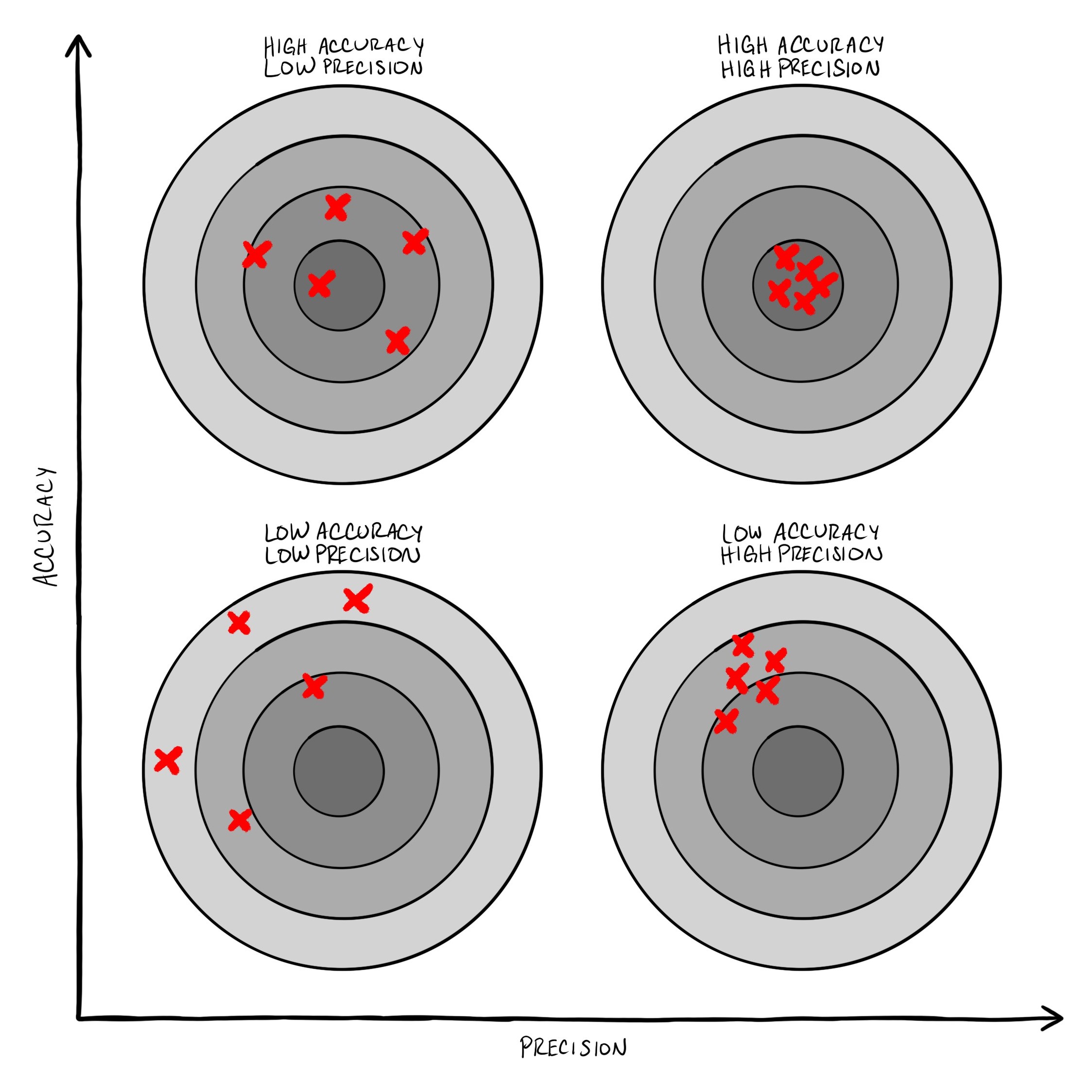
It is critical to distinguish between accuracy and precision.
- Precision (Repeatability): The variation in reported position of the Tag. High precision means low noise or “jitter.”
- Accuracy (Truth): The deviation of the reported position from the actual physical location.
 |
|---|
| Figure 1: Target Plot of Accuracy vs Precision |
Addressing Accuracy
Accuracy is primarily a function of installation quality and environmental conditions rather than system tuning. Because the location engine relies on precise timing measurements, the following factors determine absolute accuracy
- Anchor Survey: If the physical coordinates of an Anchor are measured incorrectly, every Tag location derived from that Anchor will contain a static bias.
- Line-of-Sight (LoS): In Non-Line-of-Sight (NLoS) conditions, signals must pass through or around obstacles. This slows the signal or increases the path length, causing the Tag to appear further away than it truly is.
- Placement Calibration: While the system hardware is factory calibrated, site-specific factors (such as mounting Anchors near large metal beams) can introduce inaccuracies.
While the CUWB Location Engine can mitigate some dynamic errors, static accuracy errors must be resolved through proper survey techniques, ensuring clear LoS where possible, or application-level adjustments of locations. See the Component Placement Guide for more information.
Addressing Precision
Precision is the primary performance characteristic that can be managed through system configuration. Poor precision manifests as ‘noise’ or ‘jitter’ in the position output. The goal of a high-performance deployment is to minimize the standard deviation of this noise to create a smooth, reliable position track.
The remainder of this application note addresses techniques for improving precision through system design and the use of CUWB features.
Temporal Density
An effective and simple way to improve precision without adding infrastructure is oversampling.
The Math of Averaging
In Line-of-Sight environments, UWB ranging error is widely accepted to follow a Gaussian (Normal) distribution. Gaussian noise is random and zero mean and as a consequence it tends to average out over time.
According the the Law of Large Numbers, the standard error of the mean decreased by the square root of the number of samples, N.
The CUWB system incorporates several filtering techniques, including a simple average window filter. This simple average is calculated as the moving average of position data over the preceding N positions, where N is defined by the smoothing factor.
Measured Performance - Simple Average Smoothing
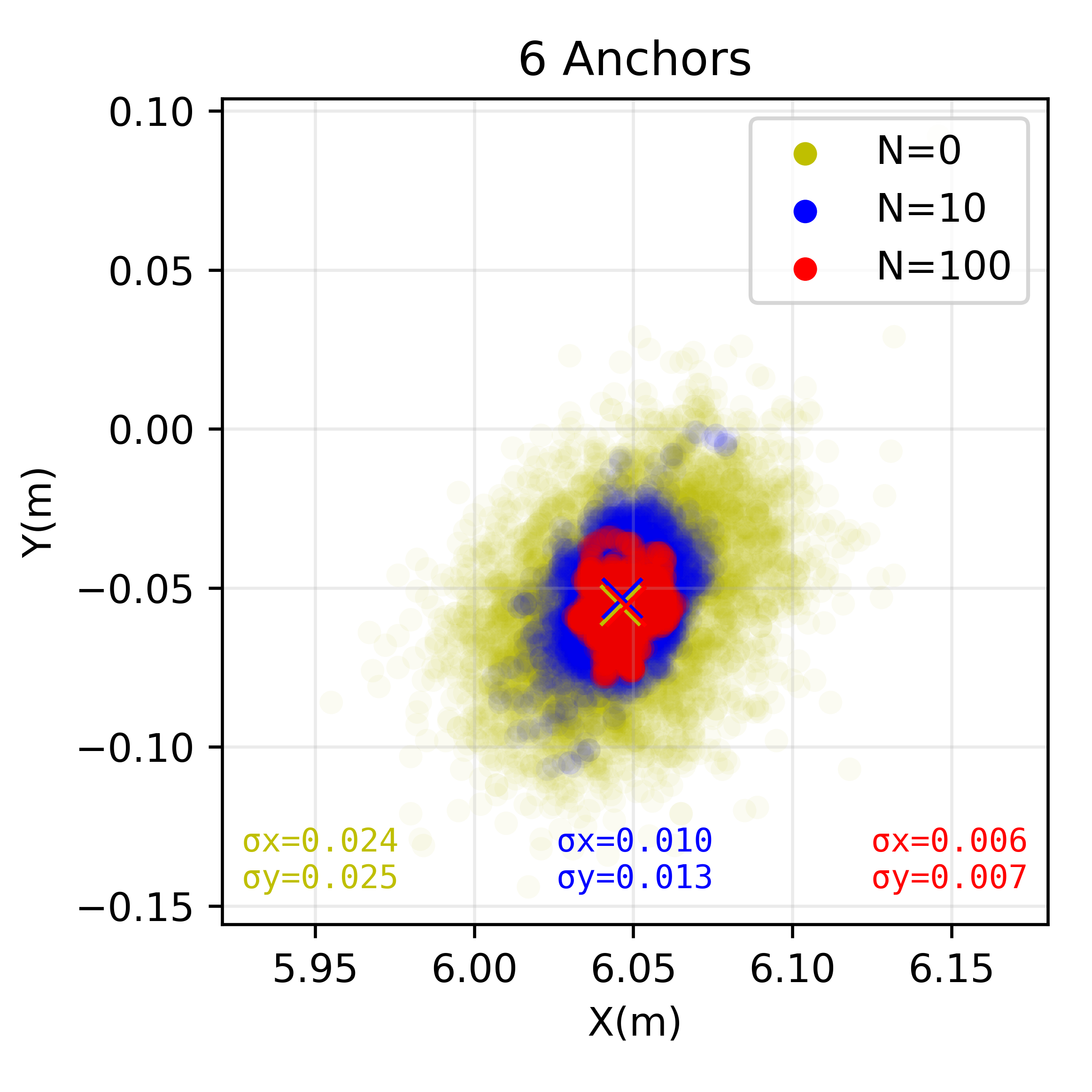
Reference: The following example is derived from our published Precision Data Test Set. Users can verify these results by reviewing Tag serial number 01:12:0080 in the MultiTime, Channel 9, 100 Hz, 6 Anchor dataset.
To provide transparency regarding actual system performance, Ciholas publishes raw test data and system logs from real-world environments. This allows users to verify our specifications against actual recorded logs rather than relying solely on theoretical models.
Ideally, real-world data would perfectly track the curve described in Section 3.1. However, physical environments introduce variables such as reflections or thermal drifts that can persist longer than a single sample duration. When errors are persistent rather than purely random, they resist averaging. Despite these physical realities, the data show that oversampling transforms the system’s precision performance.
 |
|---|
| Figure 2: XY plot of Tag 01:12:0080 using 6 anchors, MultiTime, Channel 9, 100 Hz |
In the linked dataset, we observe a Tag with a raw precision standard deviation () of approximately 2.5 cm in the X and Y axis when tracked by six Anchors in Channel 9 Multi-Time mode at 100Hz update rate. This standard deviation is representative of many high-performance CUWB installations. In the test setup, this Tag remains stationary for the duration of the test while varied smoothing levels are applied and the resultant standard deviation is recorded.
| Samples Smoothed | Smoothed Rate1 | Calculated Standard Deviation | Measured Standard Deviation |
|---|---|---|---|
| 0 (Raw Data) | 100 Hz | - | 2.5 cm (0.025 m) |
| 10 | 10 Hz | 0.79 cm (0.0079 m) | 1.15 cm (0.0115 m) |
| 100 | 1 Hz | 0.25 cm (0.0025 m) | 0.65 cm (0.0065 m) |
1. When using smoothing, the CUWB system delivers output data at the nominal configured rate while smoothing the last N-samples on a sliding window. A user needing the ‘equivalent rate’ to meet latency requirements for their system can run at a higher rate, smooth N samples, and achiever better precision without sacrificing latency.
Applying N = 10 smoothing reduces the real-world standard deviation to 1.15 cm. Further increasing to N = 100 smoothing achieves a real-world standard deviation of 0.65 cm, demonstrating a consistent and significant reduction in standard deviation as smoothing is increased.
The CUWB Series 300 supports Tag beacon rates up to 100 Hz. This allows deployments to apply aggressive smoothing algorithms to reduce positional jitter while maintaining the responsiveness required for high-speed tracking. See Tag Roles for instructions to setup beacon rates for Tags.
Spatial Density
Another important lever for performance is the number and placement of Anchors participating in the solution.
Anchor Utilization
Typical UWB RTLS use triangulation or trilateration, which limits the total number of Anchors in the output solution. When additional Anchors are available, these systems must address the overdetermined solution.
CUWB’s Location Engine is capable of utilizing data from all available Anchors, including Quiet Anchors, to calculate a single location. In high-density deployments, a single Tag location could be calculated using inputs from 20 or more Anchors simultaneously. For more information, see APD001.
Weighting Optimization
The Location Engine applies advanced weighting algorithms to the underlying timing data received from each Anchor. Anchors providing high-quality measurements and favorable geometry are prioritized, while Anchors with weak or noisy data are de-weighted. This ensures the solution is always driven by the best available data. For more information, see APD001.
Resilience and Occlusion
High Anchor density also provides resilience against environmental occlusions. In a warehouse environment, a forklift may temporarily block the LoS to five Anchors. In a sparse system, this could result in a complete loss of tracking or a significant position jump. In a high-density deployment, eight to fifteen other Anchors are likely to maintain a clear view, allowing the Location Engine to continue tracking without interruption. See the Component Placement Guide for Anchor and Tag placement considerations.
Geometric Dilution of Precision (GDOP)
GDOP is a multiplier of error based on geometry. If Anchors are clustered together or form a straight line, the intersection of their position measurements becomes elongated and uncertain.
By increasing the number of Anchors and employing strategic placement around the tracking area, GDOP improves and precision uncertainty decreases. This locks the Tag position into a tighter best-fit position, significantly reducing the geometric amplification of error.
Measured Performance - Anchor Count
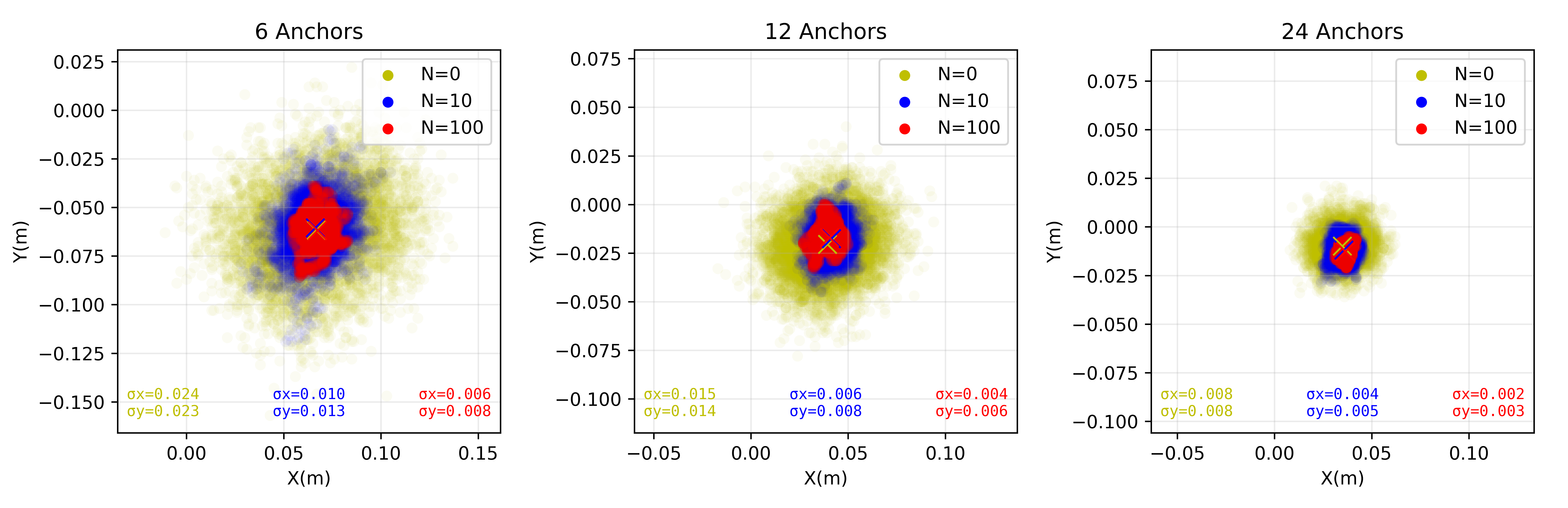
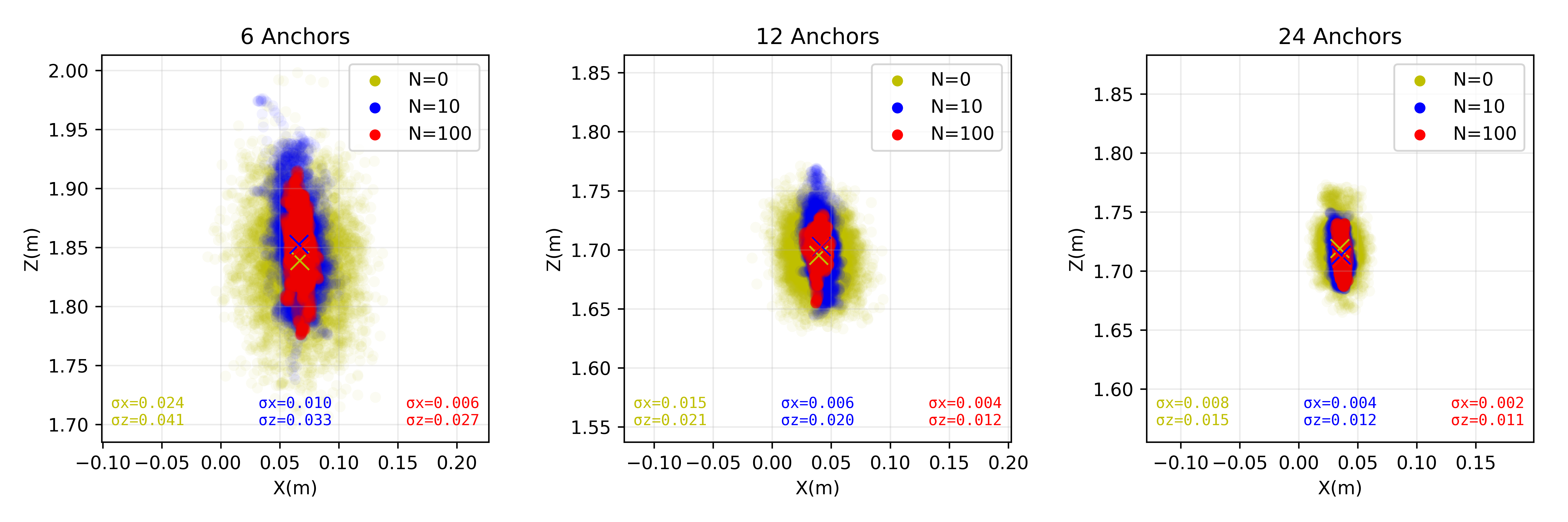
Reference: The following example is derived from our published Precision Data Test Set. Users can verify these results by reviewing Tag serial number 01:12:007F in the MultiTime, Channel 9, 100 Hz dataset.
 |
|---|
| Figure 3: XY plots of Tag 01:12:007F using MultiTime, Channel 9, 100 Hz |
 |
|---|
| Figure 4: XZ plots of Tag 01:12:007F using MultiTime, Channel 9, 100 Hz |
To demonstrate the impact of spatial density on precision, we provide raw test data comparing the same static point solved with varying numbers of participating Anchors. The data below reflects raw position measurements (no smoothing) to isolate the effect of Anchor count.
- 6 Anchors: With a minimal anchor set, the raw position shows a standard deviation of approximately 2.4 cm in X, 2.3 cm in Y, and 4.1 cm in Z.
- 12 Anchors: Doubling the participating Anchors significantly reduces noise. Standard deviation drops to 1.5 cm in X, 1.4 cm in Y, and 2.1 cm in Z. Note that while this test installation is optimized for X- and Y-axis performance, the Z-axis also benefits from additional anchors participating in the solution.
- 24 Anchors: Utilizing 24 Anchors refines the raw precision to sub-centimeter levels in the horizontal plane: 0.8 cm in X, 0.8 cm in Y and further reduces Z-axis noise to 1.5 cm.
By increasing the number of Anchors in the solution, the system converges on a more stable intersection of inputs, naturally suppressing the noise contributed by any single RF path.
System Design Trade-Offs and Mitigations
While increasing beacon rates and Anchor density improves performance, these choices introduce specific trade-offs that must be accounted for during the planning phase.
Beacon Rates vs Capacity
The CUWB System has a finite capacity, measured in Locates per Second (LPS). Increasing the beacon rate of individual Tags consumes this budget, reducing the total number of Tags the system can support.
- High Capacity Scenario: A warehouse tracking 3,000 pallets may run Tags at 1 Hz to maximize the device count.
- High Precision Scenario: A robotics lab tracking 30 AGVs may run Tags at 100 Hz to maximize precision while maintaining responsiveness.
Users must balance the required smoothness of the tracking against the total population of Tags in the zone.
It should be noted that Tags in the CUWB system can operate at different beacon rates and can be switched between beacon rates dynamically. Some users employ forms of geofencing to optimize this trade-off by moving Tags from lower-beacon rate Roles to higher-beacon rate Roles based on their physical locations. See our American Football Deployment as an example of this use case.
Anchor Density vs Infrastructure Cost
Increasing Anchor density directly increases hardware and installation costs. More Anchors require additional cabling, switch ports, and mounting labor. The CUWB System mitigates much of this trade-off with its ChainPoE™ technology and flexible mounting options.
Designers should also consider zoning their Anchor density. It is often efficient to deploy a sparse Anchor array grid for general tracking areas and increase density only in critical zones where improved precision is required.
Revision
| Version | Date | Change Description |
|---|---|---|
| 5.0.0 | 2026-02-10 | Initial Preliminary Release |